
Possibly
drivers had no mutual understanding
rich people driving luxury vehicles forced other cars off the road
drivers drove fast
no respect of traffic rules(which don't even exist).

A number of articles in the Cambodian Daily over the past few days have focused on safety. In today’s (
Other modes of public transport are often not in better shape. Buses do not tend to be safety first vehicles; using Cambodian roads are dangerous enough without emphasizing Cambodian roads fair share of inexperienced and carefree drivers combined with the fact that many vehicles (incl. buses) have the steering wheel on the wrong side and lack maintenance and the poor condition of the roads themselves. In a recent blog posting (
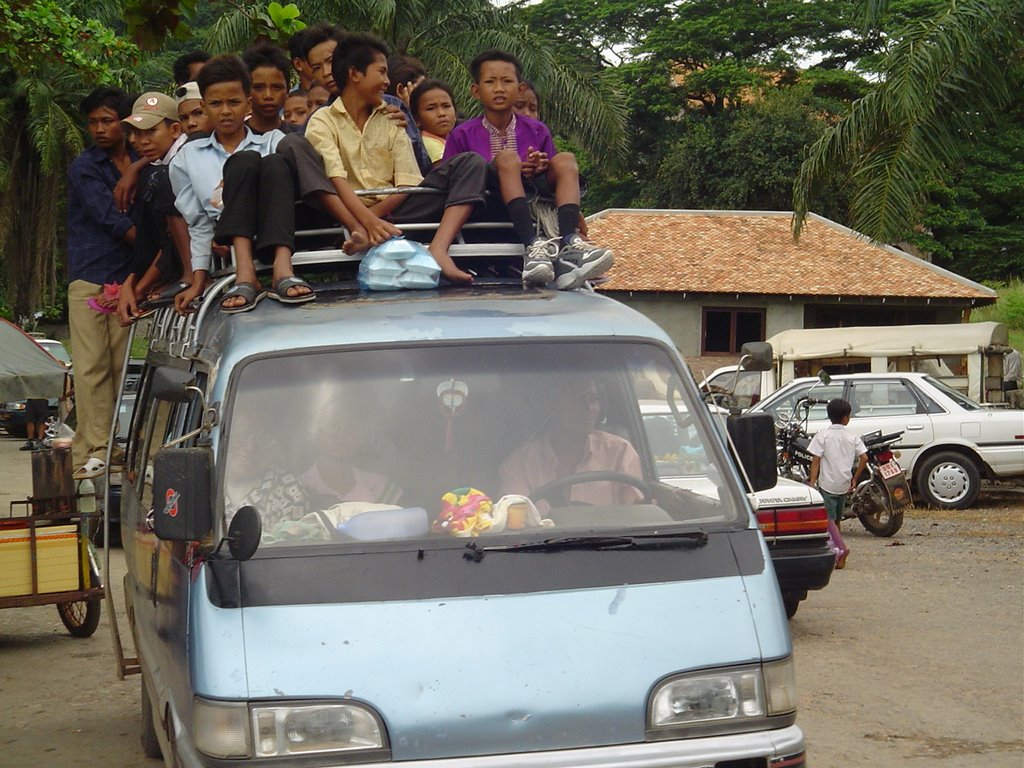
The next step down in the public transport are minivans which, oddly enough, provide long haul travel. They are often over packed (see photo’s elsewhere):passengers up front and on top; freight in the back or on top. Last week Thursday’s Cambodian Daily (
For local transport there is the ‘remorque’ : a motorcycle with a big trailer behind. Remorque is French for to tow. This type of vehicle must be very Cambodian, there is definitely no Wiki page available on this. What’s more, if the draft version of the traffic law is accepted the remorque will probably cease to exist. The towed trailer is a bit deep and loose planks are laid from side to side which are meant as the seats. Often these are over loaded, 20-30 passengers is no problem. A major safety issue is that the trailer can easily cause the motorcycle front wheel to make a wheelie and thus steeringless. Luckything is that these motorcycles can’t drive fast.

Further down the list of public travel options are long/short haul taxi’s which are packed toi the brim (4 peopleon the two front seats). Last week I saw one with two persons in baggage boot. The boot lid was up and each sat on a side of the car holding the lid.
What they have in common is that they are all highly dangerous vehicles.
But having your own vehicle is not always a guanrantee for safety. In the police blotter from the Phnom Penh Post (Sept 21- October 5), 4 of the 17 articles mention motocycles being stolen at gun-point/knife point! Three of the four cases the victim was shot or stabbed, the other case one of the robbers was shot by a ‘anonymous’ who then stole the robbers’ motorcycle!
Today’s blog seems to be loosing the point. The Cambodian Daily again of
Safety issues:
| | | | | | | | | |
| | GNI (US$) | Vehicles per | % 2/3 wheelers | Fatalities | Fatalities per | Injuries | Estimated loss to GDP | |
| | 350 | 33 | 75.2 | 824 | 16 | 6329 | 3.2% | |
| Lao PDR | 400 | 47 | 80.1 | 426 | 17 | 6699 | 2.7% | |
| | 540 | 148 | 94.4 | 20400 | 7 | 13186 | 2.5% | |
| | 2490 | 391 | 70.9 | 13116 | 0.6 | 69313 | 2.1% | |
| | 250 | 13 | 65.4 | 1987 | 42 | 4390 | | |
| | 440 | 19 | 66.6 | 3150 | 103 | 3026 | | |
| | | | | | | | | |
But clearly the scope for improvement is needed, most incidents occurring needn’t. Even with new laws the drop may not occur. Firstly there is the case that police enforcement is unsure, secondly the number of vehicles being registered is growing very fast so even new law and enforcement would only result in a smaller growth of unsafetiness.

